
Shoulder shrug stress test reveals how your nervous system quietly stores mental pressure and vigilance inside the muscles of your neck and shoulders without you noticing.
Take a moment right now.
Let your arms hang loosely.
Drop your shoulders as if they were melting downward.
Exhale slowly.
Did your shoulders actually move?
Most people realize they were subtly lifting or tightening their shoulders without awareness. This low-grade contraction happens while typing, scrolling, driving, concentrating, worrying, listening, or anticipating.
The shoulders are not just mechanical structures.
They are a neurological stress dashboard.
30-Second Self-Test: Detecting Hidden Shoulder Tension
You can run the shoulder shrug stress test immediately.
- Sit or stand comfortably.
- Let your arms rest naturally at your sides.
- Close your eyes for 10 seconds.
- Notice the position of your shoulders — height, tightness, symmetry.
- Now intentionally shrug your shoulders up toward your ears for two seconds.
- Release completely and let gravity pull them down.
Observe carefully:
- Did the release feel larger than expected?
- Did your breathing deepen automatically?
- Did your neck soften or lengthen slightly?
- Did a small wave of mental relief appear?
Most people discover that their shoulders were partially engaged even when they felt “relaxed.”
That unconscious engagement is exactly what the shoulder shrug stress test exposes.
Why the Shoulders Become a Stress Storage Zone
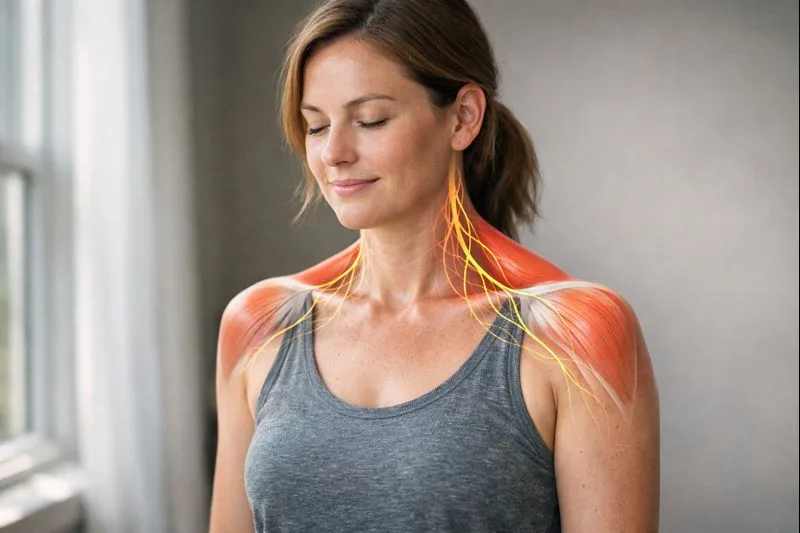
The shoulder and neck region is neurologically dense.
It integrates:
- Postural control
- Head stabilization
- Visual alignment
- Threat readiness
- Breathing mechanics
- Emotional expression
Key muscles such as the trapezius, levator scapulae, and deep cervical stabilizers respond quickly to nervous system arousal.
When the brain detects cognitive load, uncertainty, or emotional vigilance, it often increases tone in these muscles automatically.
This prepares the body for:
- Protection of the neck and head
- Rapid orientation toward stimuli
- Stabilization during movement
- Defensive readiness
Even when no physical threat exists, the nervous system still activates these ancient protective patterns during modern stress.
Mental pressure becomes muscular posture.
Why You Rarely Feel the Tension Building
Low-grade muscle activation does not trigger pain signals immediately.
The nervous system treats it as background posture — just like sitting or standing.
Over time, your brain recalibrates what “neutral” feels like.
This means:
- Mild tension feels normal
- Only strong contraction becomes noticeable
- Chronic tightness becomes invisible
Many people only realize shoulder tension when:
- Neck pain develops
- Headaches appear
- Upper back stiffness accumulates
- Range of motion decreases
- Fatigue increases
- Massage reveals tenderness
The tension has often been present for months or years before awareness catches up.
The shoulder shrug stress test short-circuits that blind spot.
The Autonomic Link: Vigilance Lives in the Shoulders
Shoulder tension reflects autonomic nervous system balance.
When sympathetic activity increases (stress, urgency, vigilance):
- Shoulder muscles tighten
- Neck shortens subtly
- Breathing becomes shallower
- Head posture stiffens
- Micro-movement decreases
This stabilizes the body for fast reaction — even if the “threat” is just cognitive workload or emotional tension.
When parasympathetic tone rises (safety, rest):
- Shoulders drop
- Muscles soften
- Breathing deepens
- Neck lengthens
- Facial tension decreases
The shoulders act like a real-time indicator of nervous system state.
Why Focus and Screens Amplify Shoulder Tension
Modern life strongly biases shoulder activation.
When you focus intensely:
- Visual system narrows attention
- Head subtly leans forward
- Arms stabilize for fine control
- Shoulder girdle stiffens to reduce motion noise
This creates a posture of containment and precision.
Screens amplify this effect:
- Eyes fixate
- Neck holds steady
- Hands hover
- Shoulders brace subconsciously
Hours of this pattern accumulate tension silently.
The shoulder shrug stress test reveals how deeply this habit is embedded.
The Feedback Loop Between Shoulders and Mind
Muscle tension is not only a result of mental state — it feeds back into it.
Tense shoulders send continuous sensory input to the brain that reinforces:
- Alertness
- Vigilance
- Readiness
- Stress signaling
This feedback loop keeps the nervous system slightly elevated even when no external stress exists.
Releasing shoulder tension can rapidly influence:
- Breathing depth
- Heart rate variability
- Perceived calm
- Mental clarity
- Emotional softness
Small mechanical changes propagate through the entire nervous system.
Long-Term Effects of Chronic Shoulder Tension
Persistent shoulder elevation and stiffness can influence:
- Neck pain and cervical compression
- Tension headaches
- Nerve irritation
- Postural imbalances
- Breathing efficiency
- Sleep quality
- Emotional irritability
- Fatigue
These effects often develop slowly, making them easy to normalize and ignore.
The shoulder shrug stress test gives you early visibility into this accumulation.
Why Awareness Alone Changes the Pattern
Once you start noticing shoulder tension, the nervous system adapts.
You become sensitive to:
- When shoulders rise
- What triggers it
- How fast they relax
- How posture influences mood and focus
This awareness creates a self-regulating loop instead of an unconscious habit.
The test is not about correcting posture — it is about revealing automatic patterns.
How This Connects to Other Everyday Signals
Shoulder tension links directly with:
- Jaw clenching
- Blink rate
- Breathing rhythm
- Postural alignment
- Attention narrowing
- Emotional reactivity
These signals form a network of bodily expression of mental load.
Learning to observe them turns your body into a real-time biofeedback system.
What the Shoulder Shrug Stress Test Teaches
Your nervous system constantly converts invisible mental states into visible physical patterns.
The shoulders are one of the clearest storage zones for that conversion.
When you learn to read them, you gain direct access to nervous system regulation — without devices, apps, or metrics.
Your body already communicates everything you need to know.
The Deeper Insight
Stress is not only something you think.
It is something you physically carry.
Often, it lives quietly in your shoulders long before your mind notices it.
Seeing it changes how you relate to your own nervous system.
Next Recommended Experiment
Continue with:
“The Posture Mood Shift Test: How Your Spine Position Changes Your Emotional State.”
This experiment explores how spinal alignment feeds back into emotional regulation, breathing patterns, and nervous system balance during everyday behavior.

Dr. Ethan Marlowe is a science communicator specializing in human biology, neuroscience, and the hidden mechanisms of the body. He focuses on transforming complex research into clear, engaging explanations that help readers understand how their bodies work. At The Human Body Facts, Ethan brings curiosity, accuracy, and a modern scientific approach to every article.