
Phantom vibration is the sensation of feeling your phone vibrate when no notification actually occurred.
Your pocket buzzes.
You reach for your phone.
Nothing is there.
No alert.
No sound.
No vibration.
Yet the sensation felt completely real — strong enough to trigger movement, attention, and emotional expectation.
Phantom vibration is one of the clearest everyday examples of how the brain can generate physical sensations without any external stimulus. It exposes how prediction, habit, and attention reshape perception at a neurological level.
Your nervous system did not malfunction.
It executed exactly what it was trained to do.
15-Second Self-Test: Triggering Phantom Vibration
You can observe phantom vibration directly.
- Place your phone inside your pocket or against your thigh.
- Sit still for 30–60 seconds.
- Focus attention on the exact contact area between phone and skin.
- Intentionally anticipate a notification arriving.
- Observe any subtle bodily sensations.
Many people notice:
- Light buzzing or pulsing
- Pressure illusions
- Micro-muscle twitches
- Tingling sensations
- Brief vibration-like flashes
Even if nothing happens externally, the nervous system may still generate sensation.
This is phantom vibration occurring in real time.
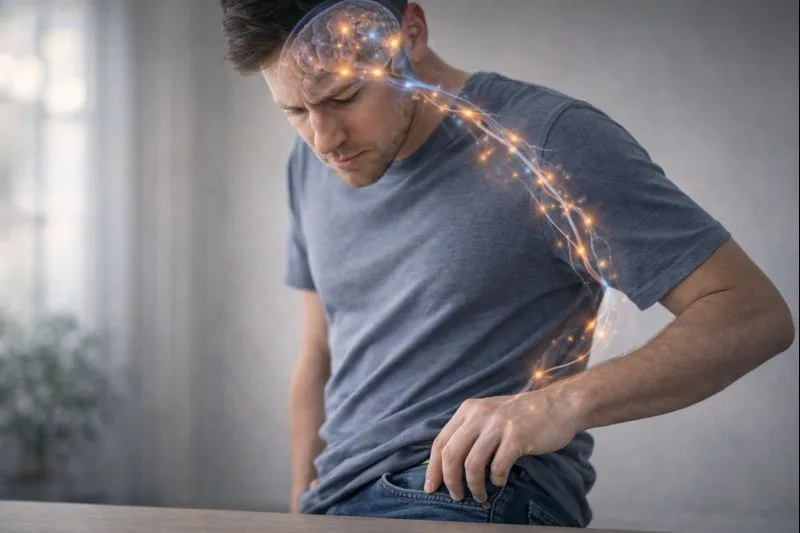
The Brain Is Not Reactive — It Is Predictive
Your brain does not wait for sensory input and then react.
It continuously predicts what it expects to experience next.
Incoming sensory data is used mainly to confirm or correct those predictions. This framework is known as predictive processing.
Perception is not a camera.
It is a simulation constrained by feedback.
The brain builds internal models about:
- What usually happens next
- Where signals typically appear
- How strong those signals are
- How frequently they repeat
- What actions follow them
When predictions are strong and consistent, the nervous system prepares sensory circuits in advance. If the predicted signal fails to arrive, the preparation itself can sometimes cross the threshold of conscious perception.
That is how phantom vibration emerges.
Why Phantom Vibration Feels Completely Physical
The somatosensory cortex does not distinguish between externally generated signals and internally generated ones.
It responds only to neural firing patterns.
If neurons activate in the same configuration that normally represents a vibration on the skin, the conscious experience feels identical — regardless of where the signal originated.
Your brain experiences patterns, not causes.
This is why dreams feel physically real while you are inside them. The same sensory maps activate, only driven internally rather than by the environment.
Phantom vibration is a miniature version of the same phenomenon: a small hallucination produced by expectation and conditioning.
Habit Loops Program Phantom Vibration
Every real phone notification strengthens a loop:
- Sensory input (vibration)
- Attention spike
- Dopamine release
- Motor response (checking phone)
- Emotional feedback
Over hundreds or thousands of repetitions, the nervous system compresses this sequence into an automatic prediction pattern.
The brain begins preparing the vibration sensation before it actually happens — a process known as sensory pre-activation.
Eventually, the pre-activation itself can become strong enough to be consciously felt, producing phantom vibration even when no notification occurs.
The more frequently you receive notifications in the same location on your body, the stronger this conditioning becomes.
Attention Amplifies Sensory Noise
Your nervous system constantly generates low-level background neural activity.
Normally, this noise is filtered out.
Attention increases neural gain.
When you focus on a specific body region or expectation, small internal fluctuations become amplified and noticeable.
Phantom vibration becomes more likely during:
- Boredom
- Stress
- Anticipation
- Social monitoring
- Compulsive checking behavior
- High notification frequency
The brain raises sensitivity in the sensory map associated with the phone location. Minor internal signals become interpreted as meaningful input.
This explains why phantom vibration often appears during idle moments rather than during intense physical activity.
Phantom Vibration Exists Across Multiple Senses
The same predictive glitch occurs in other sensory domains:
- Hearing your name in silence
- Imagining notification sounds
- Feeling insects crawling when nothing is present
- Motion illusions after stepping off a treadmill
- Phantom limb sensations after amputation
- Feeling movement after a spinning ride
In each case, prediction outruns sensory verification.
Phantom vibration simply happens to be one of the most common modern expressions of this ancient neural mechanism.
Why Evolution Accepts False Alarms
From an evolutionary perspective, prediction increases survival speed.
Reacting early is safer than reacting late.
A false alarm costs little.
A missed signal can be dangerous.
Your nervous system tolerates occasional false sensations to maintain fast responsiveness and environmental readiness.
Phantom vibration is a harmless side effect of a highly efficient predictive brain.
What Phantom Vibration Reveals About Conscious Experience
You do not perceive reality directly.
You perceive your brain’s best estimate of reality.
Perception is an active construction shaped by expectation, memory, habit, and probability.
Phantom vibration exposes how thin the boundary is between internal simulation and external sensation. The nervous system constantly generates reality rather than simply receiving it.
Most of the time, prediction and reality match closely enough that the illusion remains stable.
Sometimes, prediction wins.
Can Phantom Vibration Be Reduced?
Yes. Phantom vibration decreases when prediction loops weaken.
Helpful strategies include:
- Reducing non-essential notifications
- Changing where you carry your phone
- Limiting compulsive checking behavior
- Increasing body awareness through movement
- Allowing longer uninterrupted attention periods
As the nervous system updates its prediction model, phantom vibration naturally fades.
The Deeper Insight
Your senses are not passive.
They are actively constructed.
Every sensation you feel emerges from a collaboration between expectation and sensory input. Phantom vibration shows how easily expectation can shape physical experience.
You are constantly living inside a neural model of reality — and sometimes the model runs ahead of the world.
Next Recommended Experiment
Continue with:
“Why Your Brain Sometimes Moves Before You Decide.”
This experiment explores how unconscious motor preparation and predictive timing can trigger movement before conscious intention, revealing the hidden speed of decision circuits inside the nervous system.

Dr. Ethan Marlowe is a science communicator specializing in human biology, neuroscience, and the hidden mechanisms of the body. He focuses on transforming complex research into clear, engaging explanations that help readers understand how their bodies work. At The Human Body Facts, Ethan brings curiosity, accuracy, and a modern scientific approach to every article.