
Palmaris longus presence test reveals whether your body still carries a small ancestral forearm muscle that many humans have already lost, offering a direct window into how evolution removes structures unevenly rather than all at once.
Unlike bones or organs, this muscle varies dramatically between individuals. Some people have it in both arms. Some in only one. Some not at all.
Yet its absence causes no functional deficit.
That alone tells a powerful evolutionary story.
Your body is carrying optional hardware.
30-Second Self-Test: The Palmaris Longus Presence Test
You can detect this muscle easily.
Steps:
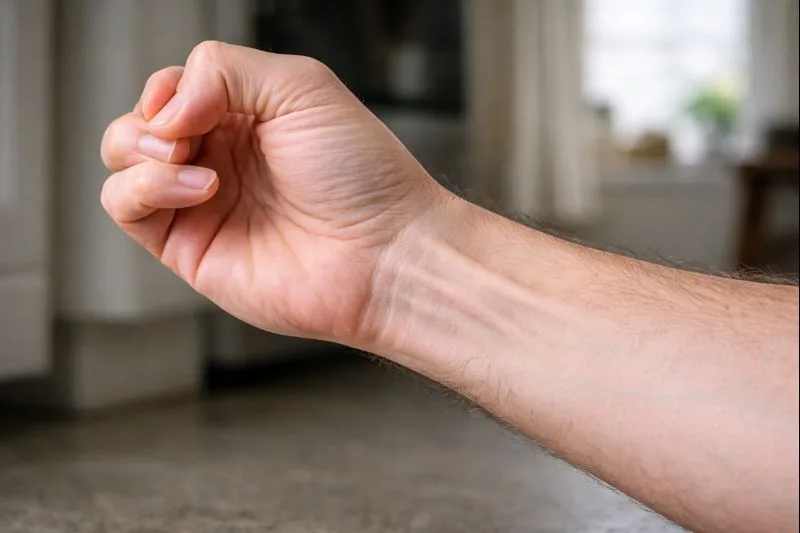
- Place your forearm facing upward on a table or in front of you.
- Touch the tip of your thumb to the tip of your pinky finger.
- Slightly flex your wrist upward while maintaining that finger contact.
- Look at the center of your inner wrist.
If you see a thin tendon or raised cord popping up in the middle of the wrist, you likely have a palmaris longus.
If nothing appears, you probably do not.
Try both arms. Many people discover asymmetry.
This test works because the palmaris longus tendon becomes visible when the muscle contracts under tension.
What the Palmaris Longus Actually Does
In species that rely heavily on climbing and gripping, this muscle contributes to:
- wrist flexion
- tensioning of the palm
- grip stabilization
- climbing endurance
In humans, its mechanical contribution is minimal.
Modern hand function relies far more on deeper flexor muscles and fine motor control.
Surgeons frequently remove the palmaris longus tendon for grafts because its absence does not impair hand performance.
This makes it one of the clearest examples of a vestigial muscle in the human body.
Why Some Humans Still Have It and Others Do Not
Evolution does not operate like software updates.
Traits fade gradually across populations.
If a structure is no longer strongly selected for or against, genetic drift determines whether it persists or disappears.
The palmaris longus is no longer critical for survival or reproduction in modern humans.
As a result:
- Some populations retain high prevalence.
- Some populations show high absence rates.
- Individual variation is large.
This variability itself is the evolutionary signal.
You are seeing natural selection relaxing its grip.
Evolutionary Origin of the Muscle
In early primates and arboreal mammals, powerful wrist flexion and palm tension improved:
- branch grasping
- climbing stability
- suspension endurance
- load distribution through the hand
The palmaris longus helped stabilize the palm during sustained gripping.
As hominins transitioned to bipedal locomotion and tool-based manipulation, the mechanical demand for that muscle decreased.
Fine motor control replaced brute grip stabilization.
The muscle became redundant.
Redundancy invites disappearance.
A Living Example of Evolution in Progress
Most evolutionary changes cannot be observed directly because they unfold across thousands of generations.
The palmaris longus is different.
You can see the transition happening inside living populations today.
Some humans still express the muscle fully.
Some partially.
Some not at all.
This is evolution operating quietly, without drama, inside normal anatomy.
Why Your Brain Still Controls a Muscle You Might Not Have
Even if you lack the palmaris longus muscle, your nervous system still carries the motor blueprint for it.
The genetic and neural architecture has not fully disappeared yet.
This is why surgeons can often stimulate residual tendon fibers or neighboring muscles in similar patterns.
Evolution removes structures slowly and unevenly across biological layers.
Hardware disappears first.
Control systems lag behind.
What This Reveals About Human Variability
Not all humans are anatomically identical.
We carry subtle differences shaped by:
- ancestry
- migration
- genetic drift
- relaxed selection pressures
These differences are usually invisible.
The palmaris longus test makes anatomical diversity visible in seconds.
Your body is a unique evolutionary snapshot.
Why Vestigial Does Not Mean Useless
Vestigial does not mean broken or defective.
It means the original adaptive purpose has diminished or disappeared.
Structures may still exist, even if their original function is no longer relevant.
Evolution optimizes for survival, not elegance.
Clinical and Anatomical Importance
Doctors often use the palmaris longus tendon for:
- reconstructive surgery
- ligament repair
- tendon grafts
Its expendability makes it biologically convenient.
Its variability also makes it a useful teaching tool in anatomy and evolutionary biology.
Why This Belongs in Evolution Leftovers
This test demonstrates:
- gradual evolutionary loss
- population-level anatomical variation
- redundancy in biological systems
- non-uniform trait disappearance
- visible evolutionary fingerprints
It shows that evolution does not erase traits cleanly.
It leaves traces.
What This Test Reveals About Your Body
Your anatomy is not only a product of current function.
It is also a historical archive.
Some parts persist simply because there was no strong reason to eliminate them yet.
Your body still carries optional components.
The Deeper Insight
Evolution is not finished with the human body.
It is still editing quietly, one generation at a time.
Some features fade slowly.
Others linger.
You are living inside an unfinished draft.
Next Evolution Leftover You Should Try
The Darwin’s Ear Tubercle Test: Why a Small Ear Bump Still Appears in Some Humans
This experiment explores a small remnant of ancestral ear shape that reflects how mammalian ears evolved and why some humans still express this structural trait today.

Dr. Ethan Marlowe is a science communicator specializing in human biology, neuroscience, and the hidden mechanisms of the body. He focuses on transforming complex research into clear, engaging explanations that help readers understand how their bodies work. At The Human Body Facts, Ethan brings curiosity, accuracy, and a modern scientific approach to every article.