
Darwins ear tubercle test reveals a small anatomical remnant that quietly persists in some human ears — a tiny bump along the outer rim that traces back to how mammalian ears evolved long before modern humans existed.
Most people never notice it.
Some see it immediately once pointed out.
Others don’t have it at all.
Yet this small fold of cartilage carries a surprisingly deep evolutionary story.
It is known as Darwin’s tubercle.
30-Second Self-Test: The Darwin’s Ear Tubercle Test
You can check for this feature easily.
Steps:
- Stand in front of a mirror or use your phone camera.
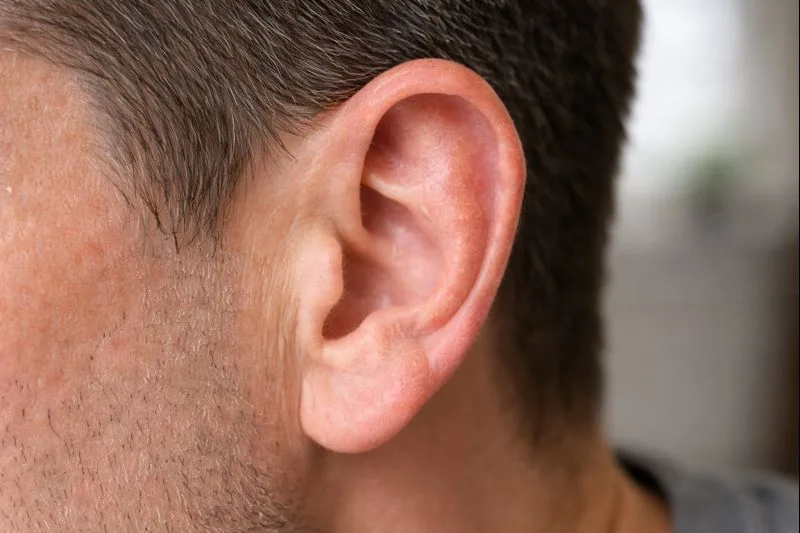
- Look closely at the upper outer rim of your ear (the helix).
- Search for a small bump, point, or thickened fold along that rim.
- Compare both ears. The feature may appear on only one side.
If you notice a small raised nub or angled protrusion along the helix, you likely have a visible Darwin’s tubercle.
If your ear rim appears smooth and uninterrupted, you probably do not.
Both outcomes are normal.
This variation itself is the evolutionary signal.
What Darwin’s Tubercle Actually Is
Darwin’s tubercle is a minor variation in the cartilage of the outer ear.
It does not affect hearing.
It does not provide mechanical advantage.
It does not cause health problems.
It simply exists as a leftover shape inherited from ancestral ear structures in mammals.
In many mammals, pointed or folded ear tips played roles in:
- directional sound collection
- predator detection
- spatial awareness
- thermoregulation
- communication and display
Human ears no longer rely on these functions structurally, but remnants of the original cartilage pattern remain in some individuals.
Why Charles Darwin Noticed It
Charles Darwin highlighted this feature in his work on human variation and descent.
He recognized it as a vestigial trait — a small physical marker suggesting continuity between human anatomy and ancestral mammalian forms.
At the time, such visible evidence of evolutionary inheritance helped support the idea that human anatomy did not appear suddenly or independently, but gradually evolved from earlier species.
The tubercle is subtle, but evolution often leaves subtle fingerprints.
How the Outer Ear Evolved
The mammalian outer ear (pinna) evolved to amplify and localize sound.
Different shapes alter how sound waves are filtered before entering the ear canal, improving directional sensitivity.
In animals that rely heavily on environmental awareness, ear shape is critical.
Over evolutionary time:
- cartilage folds became specialized
- ear rims developed sharper edges or points
- muscles allowed ear movement and orientation
Humans gradually lost most of this specialization as vision, cognition, and tool use became dominant survival tools.
The ear no longer needed aggressive directional shaping.
But cartilage development genes did not fully erase the old pattern.
The result is partial persistence.
Why Some Humans Have It and Others Do Not
Darwin’s tubercle is controlled by developmental genetics that influence cartilage folding during embryonic growth.
The expression varies widely across populations and individuals.
Some contributing factors include:
- genetic inheritance
- developmental variability
- random gene expression differences
- relaxed evolutionary pressure
Because the trait does not significantly affect survival or reproduction, natural selection does not strongly favor or eliminate it.
Variation persists.
This is a classic example of neutral evolutionary drift.
A Living Fossil in Cartilage
Most evolutionary remnants are invisible.
They exist in DNA, neural wiring, or embryonic development.
Darwin’s tubercle is unusual because it remains externally visible.
It allows you to observe evolutionary history directly on your own body or someone else’s.
You are literally seeing a trace of ancient anatomy in modern flesh.
Why Vestigial Traits Don’t Disappear Cleanly
Evolution does not redesign organisms from scratch.
It modifies existing templates gradually.
If a structure becomes less useful but not harmful, there is little pressure to remove it entirely.
Traits may:
- shrink
- weaken
- fragment
- become inconsistent
- vary across individuals
Darwin’s tubercle sits in this gray zone.
It is neither useful nor harmful.
So it lingers.
Similar Vestiges in Human Anatomy
Darwin’s tubercle belongs to a broader category of evolutionary leftovers, including:
- the appendix
- palmaris longus muscle
- wisdom teeth variability
- goosebumps and body hair response
- coccyx remnants
- variable rib counts
Each reflects a past environment or function that no longer defines modern survival.
Why Your Brain Still Builds the Pattern
Even if you do not have a visible tubercle, your developmental blueprint still contains instructions for ear cartilage folding.
Small shifts in gene expression determine whether the bump appears.
This illustrates how evolution works on probability, not precision.
Traits fade gradually through variability before disappearing completely — if they ever do.
Cultural and Aesthetic Perception
Some people interpret Darwin’s tubercle as:
- a unique aesthetic feature
- a marker of individuality
- a curiosity
- a genetic quirk
In some cultures, it has even been mythologized.
Scientifically, it is simply anatomical variation shaped by deep time.
Why This Belongs in Evolution Leftovers
This test demonstrates:
- visible evolutionary remnants
- genetic variability in modern humans
- neutral trait persistence
- gradual anatomical fading
- continuity between mammals and humans
It closes the category by reminding readers that evolution leaves signatures not only in function, but in form.
What This Test Reveals About Your Body
Your anatomy is not optimized solely for the present.
It carries echoes of environments, behaviors, and structures that no longer exist.
Some of those echoes are small enough to overlook.
Until you look closely.
The Deeper Insight
Evolution does not erase history.
It layers new solutions on top of old ones.
Your body is a living archive — sometimes the archive is written directly into the shape of your ear.
Next Evolution Leftover You Should Try
The Palmar Grasp Reflex Test: Why Babies Still Cling and What It Reveals About Our Primate Past
This experiment explores how early neural reflexes persist across generations, revealing behavioral traces of ancient survival strategies embedded in the human nervous system.

Dr. Ethan Marlowe is a science communicator specializing in human biology, neuroscience, and the hidden mechanisms of the body. He focuses on transforming complex research into clear, engaging explanations that help readers understand how their bodies work. At The Human Body Facts, Ethan brings curiosity, accuracy, and a modern scientific approach to every article.