
Cold face diving reflex test reveals how brief exposure of your face to cold water can instantly slow your heart rate, redistribute blood flow, and shift your nervous system into a deep conservation mode within seconds.
You don’t need extreme cold.
You don’t need long breath holds.
You don’t need athletic conditioning.
A simple facial contact with cool water is enough to activate one of the oldest survival reflexes embedded in the human nervous system.
Your pulse drops.
Breathing adjusts.
Circulation reorganizes.
The body enters a protective state.
This response is not psychological.
It is hard-wired biology.
30-Second Self-Test: Triggering the Diving Reflex Safely
Safety note:
Do not perform this test if you have known cardiac rhythm disorders, fainting history, severe cold sensitivity, or respiratory instability. Use cool tap water — not ice.
You will need:
- A bowl or sink with cool water
- A calm seated position
- Optional: a watch or pulse sensor
Steps:
- Sit comfortably and breathe normally for about 30 seconds.
- If possible, measure your resting heart rate (count beats for 15 seconds ×4).
- Take a normal breath — not a deep inhale.
- Gently immerse your face into the cool water for 10–15 seconds. Keep your mouth and nose submerged.
- Lift your face and breathe normally again.
- Observe your pulse, breathing, and internal sensations.
Common sensations include:
- A noticeable slowing of the heartbeat
- A heavy or grounded feeling in the chest
- Mild breath suppression or calm
- Cool pressure across the face
- A quieting of internal agitation
Even without precise measurement, many people can feel the cardiovascular shift directly.
That shift is the diving reflex activating.
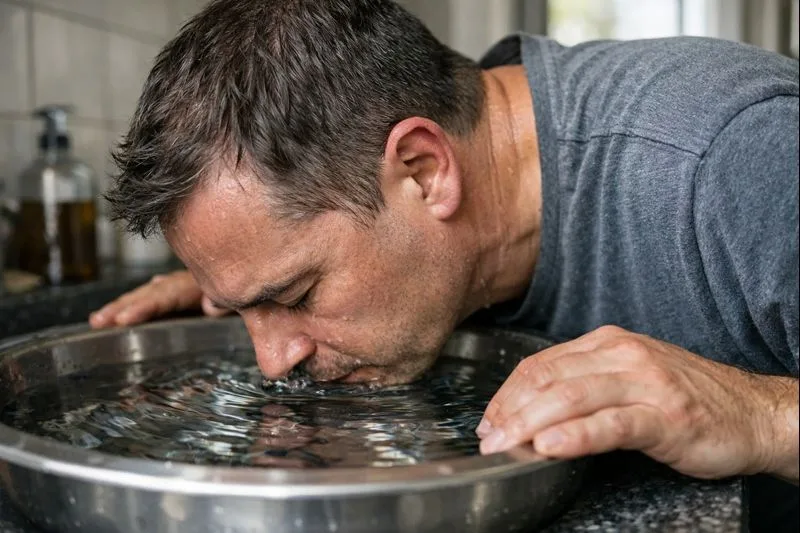
Why the Face Has Direct Access to Your Heart
The skin of the face is densely packed with cold receptors connected to the trigeminal nerve.
This nerve sends fast sensory signals directly into brainstem autonomic centers that regulate:
- Heart rhythm
- Blood vessel tone
- Breathing control
- Oxygen conservation
When cold water contacts the face, especially around the nose and cheeks, the nervous system interprets it as potential submersion.
The brain does not wait for logic or context.
It activates survival protocols immediately.
Parasympathetic output increases.
Heart rate slows.
Peripheral circulation tightens.
Oxygen is prioritized for the brain and heart.
All of this happens automatically.
The Mammalian Diving Reflex
This mechanism is known as the mammalian diving reflex.
It exists across mammals — seals, dolphins, whales, dogs, and humans. In aquatic mammals, it allows long underwater dives by aggressively conserving oxygen.
In humans, the reflex is milder but still robust and measurable.
Core components include:
- Bradycardia: slowing of heart rate
- Peripheral vasoconstriction: reduced blood flow to limbs and skin
- Oxygen conservation: prioritization of vital organs
- Respiratory modulation: brief breathing suppression
The circuitry lives deep in the brainstem and operates below conscious control.
You cannot will it on or off.
What Happens Inside the Heart
The heart’s rhythm is controlled by a balance between sympathetic (accelerating) and parasympathetic (slowing) signals.
Cold facial stimulation sharply increases parasympathetic influence via the vagus nerve.
This causes:
- Slower firing of the sinoatrial node
- Longer intervals between beats
- Reduced cardiac workload
- Improved oxygen efficiency
You may feel this as:
- Calm heaviness
- Slowing awareness
- Subtle internal quiet
- Increased bodily stillness
These sensations reflect genuine physiological change, not suggestion.
Why Breathing Feels Different
At the same time, respiratory centers receive inhibitory input.
The nervous system assumes underwater conditions and briefly suppresses breathing drive.
This produces:
- Short breath holds
- Reduced respiratory depth
- A feeling of stillness in the chest
This is why cold water splashes often cause people to instinctively pause their breath.
It is a protective reflex designed to prevent water inhalation and conserve oxygen.
How Strong Is the Effect?
The magnitude of the reflex varies based on:
- Water temperature
- Area of facial exposure
- Individual autonomic sensitivity
- Baseline stress level
- Breathing timing
Some individuals experience heart rate drops of 5–15 beats per minute within seconds.
Others feel mainly subjective calm and grounding.
Both represent valid activation of the same neural pathway.
Repeated exposure often reduces intensity due to rapid neural adaptation.
Why This Reflex Still Exists in Modern Humans
Humans evolved near water sources.
Falling into cold rivers, rain exposure, coastal environments, and sudden immersion were common survival challenges.
A rapid autonomic reflex provided immediate protection without requiring conscious decision-making.
Even though modern life rarely demands underwater survival, the circuitry remains fully operational.
Your nervous system still carries ancient contingency plans.
The cold face diving reflex test exposes one of them directly.
Clinical and Research Relevance
Medical professionals sometimes use cold facial stimulation to:
- Influence certain heart rhythm disturbances
- Activate vagal tone
- Assess autonomic responsiveness
- Study cardiovascular reflex pathways
It is one of the fastest non-pharmacological methods to influence heart rate through sensory input.
This makes it a powerful demonstration of how sensory systems directly regulate core physiology.
Why This Belongs in Safe Extremes
This experiment pushes a real physiological boundary:
- Direct autonomic modulation
- Cardiac rhythm alteration
- Oxygen conservation reflex
- Brainstem control engagement
Yet when performed conservatively, it remains safe and controlled.
You are interacting directly with deep survival circuitry — not just surface sensation.
That is the essence of Safe Extremes.
What This Test Reveals About Your Body
Your heart does not respond only to exercise, emotion, or thought.
It responds instantly to sensory signals that predict environmental survival conditions.
The nervous system can override conscious state in milliseconds.
Much of your physiology operates far below awareness — yet remains accessible through simple stimuli.
The Deeper Insight
Modern comfort hides ancient biology.
Cold water on your face unlocks a direct communication channel with nervous system layers shaped millions of years ago.
You are never far from those systems.
They are always running quietly beneath the surface.
Next Safe Extreme You Should Try
Cold Gasp Reflex Test: Why Sudden Cold Makes Your Breath Spike Instantly
This experiment explores how abrupt cold exposure triggers rapid respiratory activation and sympathetic arousal, revealing how the body prioritizes oxygen intake under thermal shock.

Dr. Ethan Marlowe is a science communicator specializing in human biology, neuroscience, and the hidden mechanisms of the body. He focuses on transforming complex research into clear, engaging explanations that help readers understand how their bodies work. At The Human Body Facts, Ethan brings curiosity, accuracy, and a modern scientific approach to every article.