
Breath holding stress test reveals how your nervous system unconsciously pauses breathing during focus, tension, and cognitive load — even when you believe you are breathing normally.
Right now, pause for a moment.
Notice your breathing.
Is it slow or shallow?
Smooth or slightly frozen?
Continuous or interrupted?
Many people discover tiny breath holds they were not aware of — especially while reading, scrolling, solving problems, or concentrating.
This silent habit has powerful effects on your nervous system, energy levels, emotional state, and long-term stress load.
You don’t stop breathing on purpose.
Your brain does it automatically.
30-Second Self-Test: Detecting Unconscious Breath Holding
You can run the breath holding stress test immediately.
- Sit comfortably with your spine supported.
- Place one hand lightly on your chest and one on your abdomen.
- Breathe naturally through your nose for 20–30 seconds.
- Keep your attention on the rhythm — not controlling it.
- Observe whether the flow feels continuous or subtly interrupted.
Now introduce mild mental load:
- Read a paragraph.
- Do a quick mental calculation.
- Recall a complex memory.
Observe again.
Most people notice:
- Short pauses after inhales
- Reduced belly movement
- Shallower breaths
- Slight chest tightening
- Increased muscular stillness
This is unconscious breath holding — a micro-freeze response activated by the nervous system.
That’s exactly what the breath holding stress test reveals.
Why the Brain Pauses Breathing Under Load
Breathing is automatic, but it is tightly connected to attention and arousal systems.
When cognitive demand increases, the nervous system shifts toward stabilization:
- Muscles subtly stiffen
- Movement decreases
- Sensory noise is reduced
- Posture becomes more fixed
- Breathing becomes constrained
This creates a temporary state of control and precision.
Holding or reducing breath stabilizes the torso and increases internal pressure, which improves fine motor control and visual stability — useful during tasks that require focus or threat readiness.
The brain learned this pattern long before modern work existed.
Today, the same reflex activates during emails, screens, deadlines, and problem-solving.
Mental effort becomes respiratory tension.
The Autonomic Mechanism Behind Breath Holding
Breathing is regulated by overlapping systems:
- Brainstem respiratory centers maintain automatic rhythm.
- Autonomic nervous system adjusts depth and speed based on arousal.
- Cortical control allows voluntary modulation.
When sympathetic activation increases (stress, focus, urgency):
- Breathing becomes shallower
- Pauses increase
- CO₂ tolerance shifts
- Chest muscles engage
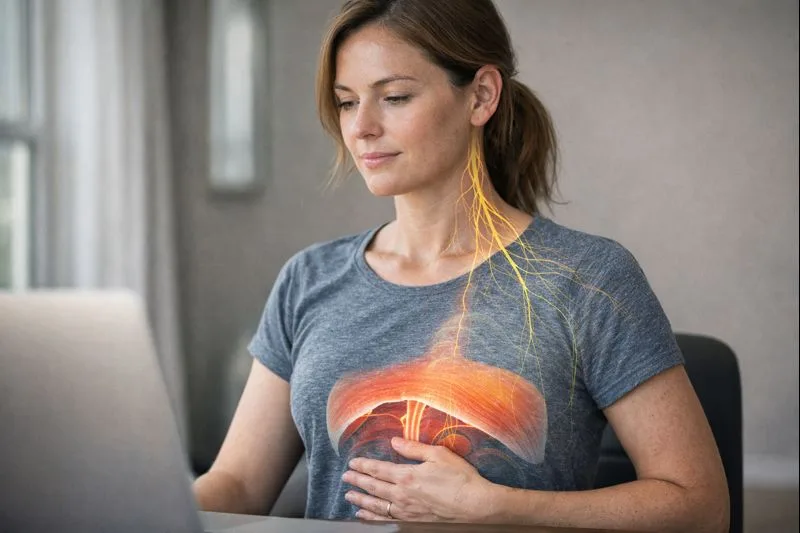
- Diaphragm movement decreases
This creates a subtle internal holding pattern.
The body enters a mild “ready” state — even if no physical action follows.
The breath holding stress test lets you feel this shift consciously.
Why You Rarely Notice It Happening
Breathing operates mostly outside awareness.
Your brain prioritizes external tasks over internal monitoring.
As long as oxygen levels remain safe, small interruptions go unnoticed.
Over time:
- Micro breath holds feel normal
- Shallow breathing becomes baseline
- Tension blends into posture
- Fatigue accumulates silently
Many people only notice breathing dysfunction when:
- Anxiety spikes
- Fatigue increases
- Headaches appear
- Neck tension builds
- Sleep quality drops
- Concentration worsens
The body had been compensating quietly.
How Breath Holding Affects the Nervous System
Unconscious breath holding influences:
- Carbon dioxide balance
- Blood pH regulation
- Heart rate variability
- Vagal tone
- Emotional regulation
- Cognitive clarity
Shallow or interrupted breathing reduces parasympathetic activity and increases baseline stress load.
Over time, this can amplify:
- Irritability
- Restlessness
- Sleep fragmentation
- Muscular tension
- Reduced recovery
Breathing is not just oxygen delivery — it is nervous system modulation.
Why Screens and Cognitive Work Intensify the Pattern
Modern environments strongly promote breath holding:
- Visual fixation reduces blink rate
- Shoulders stabilize posture
- Jaw subtly tightens
- Neck stiffens
- Breathing freezes slightly
This creates a full-body micro-immobility pattern optimized for screen interaction.
The nervous system interprets sustained attention as vigilance.
Breathing follows that signal.
The Feedback Loop Between Breath and Mental State
Breathing does not only reflect stress — it feeds it.
Shallow breathing sends sensory feedback to the brain that reinforces:
- Alertness
- Tension
- Readiness
- Emotional reactivity
Restoring smooth breathing can rapidly shift:
- Heart rhythm
- Muscle tone
- Emotional softness
- Cognitive clarity
- Perceived calm
Small respiratory changes cascade through the entire nervous system.
Why Awareness Immediately Changes Breathing
Once you notice breath holding, the nervous system updates its model.
You begin sensing:
- When holding appears
- What triggers it
- How quickly it releases
- How posture influences it
- How emotion modulates it
This awareness creates self-regulation without force or technique.
The breath holding stress test is diagnostic — not corrective.
How This Fits Into Everyday Physiology
Breath holding connects directly with:
- Jaw clenching
- Shoulder tension
- Blink rate
- Postural rigidity
- Attention narrowing
- Autonomic balance
These signals form a coordinated expression of nervous system load.
Learning to observe them turns your body into a real-time biofeedback system.
What This Experiment Teaches
Your breathing is constantly shaped by your mental environment.
Even when you think you are relaxed, subtle patterns may be signaling sustained internal pressure.
Seeing those patterns restores choice and flexibility.
The Deeper Insight
You are not only thinking stress.
You are breathing it.
Quietly, continuously, and often invisibly.
Awareness changes that relationship immediately.
Next Recommended Experiment
Continue with:
“The Posture Mood Shift Test: How Your Spine Position Changes Your Emotional State.”
This experiment explores how spinal alignment feeds back into breathing mechanics, emotional regulation, and nervous system balance in everyday behavior.

Dr. Ethan Marlowe is a science communicator specializing in human biology, neuroscience, and the hidden mechanisms of the body. He focuses on transforming complex research into clear, engaging explanations that help readers understand how their bodies work. At The Human Body Facts, Ethan brings curiosity, accuracy, and a modern scientific approach to every article.