
Achilles tendon spring test reveals how one of the most powerful elastic structures in the human body still operates as a biological spring, storing and releasing energy in a way that directly reflects early human endurance running and long-distance survival strategies.
Every step you take loads your Achilles tendon like a stretched rubber band.
When you push off the ground, that stored energy is released instantly, propelling your body forward with minimal muscular effort.
You rarely notice this mechanism because it happens automatically, hundreds of times per minute while walking, running, climbing stairs, or jumping. Yet this elastic recoil system is one of the defining biomechanical traits that separated early humans from most other primates.
Your body still carries this running hardware.
30-Second Self-Test: The Achilles Tendon Spring Test
This simple test lets you feel the elastic recoil function directly.
Steps:
- Stand upright with feet hip-width apart on a stable surface.
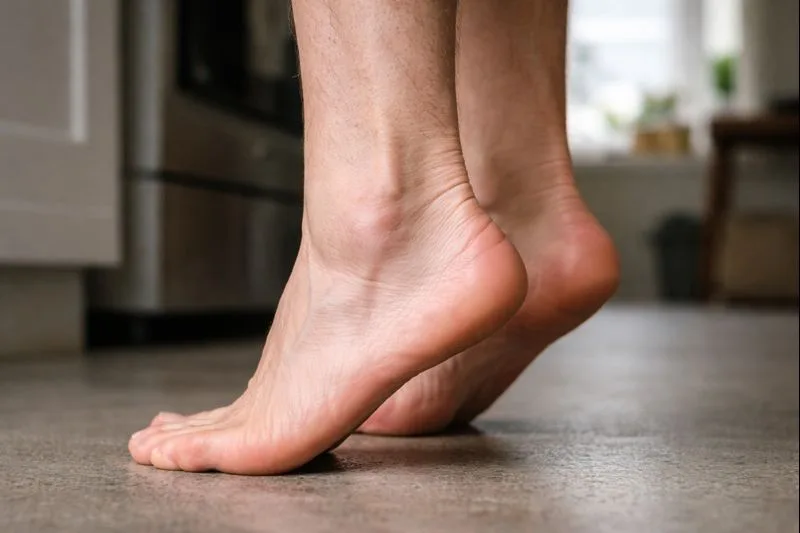
- Slowly rise onto the balls of your feet, lifting your heels off the ground.
- Lower your heels gently back down.
- Repeat this motion rhythmically for 15–20 seconds, keeping the movement smooth and spring-like.
- Pay attention to the sensation in your calves and lower legs.
Most people notice:
- A subtle elastic rebound when pushing upward
- A springy feeling rather than pure muscular strain
- Energy returning into the movement
- Reduced effort after several repetitions
You are feeling tendon elasticity contributing mechanical work.
The tendon is doing part of the job for your muscles.
Why Humans Have Such a Powerful Achilles Tendon
Among primates, humans possess an unusually long and thick Achilles tendon.
Chimpanzees and other apes have much shorter tendons because they rely more on climbing and quadrupedal locomotion rather than sustained running.
Humans evolved in open environments where long-distance walking and endurance running were critical for:
- tracking prey
- persistence hunting
- long-range travel
- thermal regulation
- survival in open landscapes
Elastic tendons dramatically reduce the metabolic cost of running.
Instead of muscles doing all the work, tendons store mechanical energy when stretched and release it during push-off, acting like biological springs.
This makes movement more efficient and sustainable over long distances.
How the Tendon Stores and Releases Energy
When your foot contacts the ground:
- Your body weight loads the Achilles tendon.
- The tendon stretches slightly under tension.
- Mechanical energy is stored within the collagen fibers.
When you push off:
- The tendon recoils.
- Stored energy is released.
- Force contributes directly to forward propulsion.
This process happens passively, without additional neural effort.
Muscles guide the movement, but the tendon supplies a significant portion of the mechanical power.
This elastic recycling reduces fatigue and improves locomotion efficiency.
Why You Feel a Spring Instead of Pure Muscle Work
If all propulsion came from muscle contraction alone:
- Energy demand would be much higher.
- Heat production would increase rapidly.
- Endurance would drop significantly.
The Achilles tendon allows mechanical energy reuse.
That spring-like sensation you feel during the test is your connective tissue temporarily acting as an energy reservoir.
This is one of the reasons humans can walk and run for long periods with relatively low energy expenditure compared to other mammals of similar size.
Evolutionary Evidence From Fossils and Anatomy
Fossil evidence shows that early Homo species developed:
- elongated lower limbs
- narrow hips optimized for stride efficiency
- enlarged heel bones
- thickened Achilles attachment points
These adaptations correlate strongly with endurance locomotion.
The tendon itself does not fossilize, but bone morphology reflects the forces transmitted through it.
Anthropologists interpret these skeletal signatures as indicators of long-distance running capacity.
The Achilles tendon spring system was a key mechanical innovation.
Why Modern Humans Still Depend on This System
Even though modern humans rarely hunt or migrate on foot, the tendon remains essential for:
- walking economy
- stair climbing
- jumping mechanics
- balance corrections
- posture stability
- shock absorption
You use it constantly without awareness.
Injury or stiffness in the Achilles tendon dramatically alters movement efficiency and increases muscular workload.
This highlights how deeply integrated this structure remains in everyday function.
The Difference Between Tendon and Muscle Work
Muscles:
- consume metabolic energy
- generate heat
- fatigue over time
- require neural activation
Tendons:
- store mechanical energy
- release energy passively
- resist fatigue
- operate without metabolic cost
This division of labor allows the body to move efficiently over long durations.
The tendon acts as a mechanical battery.
Why Stiffness Changes Performance and Injury Risk
If the Achilles tendon becomes too stiff or too compliant:
- energy transfer efficiency drops
- movement becomes less economical
- strain shifts into muscles and joints
- injury risk increases
Optimal tendon elasticity balances energy storage with stability.
Age, training load, footwear, and movement habits all influence tendon mechanical properties.
This is why runners and athletes often focus on calf and tendon conditioning.
Everyday Situations Where You Feel the Spring
You can perceive tendon recoil during:
- brisk walking
- running uphill or downhill
- skipping
- jumping rope
- quick directional changes
- climbing stairs two at a time
In each case, the tendon reduces muscular effort by recycling mechanical energy.
Why This Is an Evolutionary Leftover
The Achilles tendon spring is not optimized for sitting, driving, or desk work.
It exists because ancestral humans depended on efficient locomotion for survival.
Modern environments no longer demand this capacity daily, yet the anatomical design remains intact.
Your body still carries hardware built for endurance movement in open landscapes.
This is a functional evolutionary leftover, not a useless relic.
What This Test Reveals About Your Body
Your movement efficiency is partly mechanical, not just muscular or neural.
Elastic tissues silently contribute to every step.
Much of your locomotion is powered by stored energy, not active effort.
Your anatomy still reflects ancient survival pressures.
The Deeper Insight
Evolution shapes bodies for environments that no longer exist.
Yet those designs persist, quietly supporting modern life.
Each step you take activates a spring engineered by deep evolutionary time.
Next Evolution Leftover You Should Try
The Palmaris Longus Presence Test: How an Ancestral Muscle Reveals Hidden Variability in Human Anatomy
This experiment explores a vestigial forearm muscle that many humans no longer possess, revealing how evolutionary traits fade unevenly across populations.

Dr. Ethan Marlowe is a science communicator specializing in human biology, neuroscience, and the hidden mechanisms of the body. He focuses on transforming complex research into clear, engaging explanations that help readers understand how their bodies work. At The Human Body Facts, Ethan brings curiosity, accuracy, and a modern scientific approach to every article.