
Cold spoon skin test reveals how rapidly your nervous system detects temperature changes and transmits that information from your skin to the brain in fractions of a second.
Touch something cold and you feel it immediately.
Not after thinking.
Not after analyzing.
Not after interpretation.
The sensation appears almost instant.
That speed reflects one of the fastest sensory communication systems in the human body.
Your skin is continuously scanning the environment for thermal changes that signal danger, comfort, or environmental shifts. The moment cold touches the skin, specialized receptors fire and neural signals race toward the brain.
This experiment allows you to feel that transmission speed directly.
30-Second Self-Test: The Cold Spoon Skin Test
You will need:
- A metal spoon
- A refrigerator or cold running water
- A comfortable seated position
Steps:
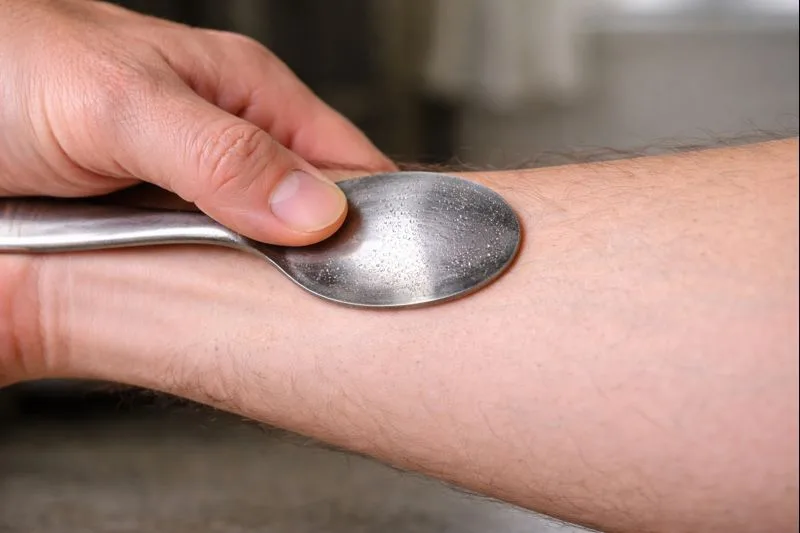
- Place the spoon in the refrigerator for at least 5–10 minutes, or run it under cold water until it feels clearly cold.
- Dry the spoon so water does not interfere with skin sensation.
- Gently press the back of the spoon against the inside of your forearm or the side of your neck.
- Notice how fast the cold sensation appears and how sharply it is localized.
- Remove the spoon and observe how long the cold after-sensation persists.
Most people experience:
- Immediate cold perception
- A sharp boundary between cold and normal skin temperature
- A brief lingering chill after removal
- Subtle changes in skin sensitivity over a few seconds
The reaction feels instantaneous because the sensory pathway is extremely fast.
Why Cold Feels So Immediate on the Skin
Your skin contains specialized sensory receptors called thermoreceptors.
These receptors are tuned to detect:
- cooling
- warming
- rapid temperature change
- potentially harmful extremes
When the spoon contacts your skin, cold thermoreceptors activate almost instantly. Electrical signals travel through sensory nerves into the spinal cord and then upward to the brain’s sensory processing regions.
This pathway is optimized for speed because temperature changes often signal environmental risk.
Cold can indicate:
- exposure to dangerous conditions
- loss of body heat
- tissue damage risk
- environmental instability
The nervous system prioritizes fast detection over detailed analysis.
How Fast the Signal Actually Travels
Sensory nerve fibers transmit electrical impulses at speeds that can reach tens of meters per second.
From your forearm to your brain, the signal may travel in a fraction of a second.
That is why you perceive cold almost immediately upon contact.
You are not waiting for conscious interpretation.
The sensation arrives already constructed.
Why Metal Feels Colder Than Other Materials
The spoon itself does not have to be extremely cold to feel intense.
Metal conducts heat efficiently.
When the spoon touches your skin:
- heat rapidly transfers from your skin into the metal
- the skin temperature drops locally
- thermoreceptors fire strongly
Materials like plastic or wood conduct heat much more slowly, so they feel less cold even at the same temperature.
The nervous system interprets heat loss rate, not just absolute temperature.
How the Brain Interprets Temperature Signals
Once the signal reaches the brain:
- the sensory cortex maps the location
- intensity is estimated
- temperature category is identified
- protective responses may activate
You may feel a reflexive urge to pull away, adjust posture, or shift contact.
This integration happens automatically and continuously.
Why the Cold Sensation Lingers After Removal
After you remove the spoon, the skin temperature slowly returns to baseline.
Thermoreceptors continue firing until equilibrium is restored.
Blood flow increases slightly to rewarm the area.
This creates the lingering cool sensation.
The nervous system tracks temperature change dynamically, not as a single snapshot.
Individual Differences in Sensitivity
Not everyone experiences identical intensity.
Cold sensitivity varies based on:
- skin thickness
- blood circulation
- nerve density
- hydration
- age
- environmental adaptation
Some people feel sharp cold immediately.
Others perceive it more gradually.
Both are normal.
Why This System Is So Important for Survival
Temperature detection protects the body from:
- hypothermia
- frost injury
- environmental exposure
- surface damage
- unsafe contact
Fast detection allows quick behavioral correction.
Move away.
Cover skin.
Change posture.
Seek warmth.
Without rapid thermosensation, tissue damage would occur before awareness.
How This Connects to Pain and Touch
Thermoreceptors interact closely with:
- pain receptors
- touch receptors
- pressure receptors
Extreme cold can activate pain pathways.
Mild cold blends with tactile sensation.
The nervous system integrates multiple sensory channels to construct a unified experience of contact.
Everyday Situations Using the Same Pathway
You rely on this system constantly:
- touching cold metal
- stepping on cool floors
- washing hands in cold water
- feeling wind chill
- sitting on cold surfaces
- holding chilled objects
The cold spoon simply amplifies the effect.
What This Test Reveals About Your Nervous System
Your sensory system is not slow or passive.
It is predictive, fast, and protective.
Signals travel before conscious thought arrives.
You experience the result of neural computation, not the raw data.
The Deeper Insight
Speed defines safety.
Your nervous system evolved to detect thermal changes rapidly because hesitation could be dangerous.
The cold spoon skin test exposes just how quickly your body reacts to the environment — even when nothing seems dramatic.
Next Recommended Experiment
Continue with:
“Two-Point Touch Discrimination Test: How Precisely Can Your Skin Map Space?”
This experiment explores how densely packed sensory receptors create detailed spatial maps across different regions of the body.

Dr. Ethan Marlowe is a science communicator specializing in human biology, neuroscience, and the hidden mechanisms of the body. He focuses on transforming complex research into clear, engaging explanations that help readers understand how their bodies work. At The Human Body Facts, Ethan brings curiosity, accuracy, and a modern scientific approach to every article.