
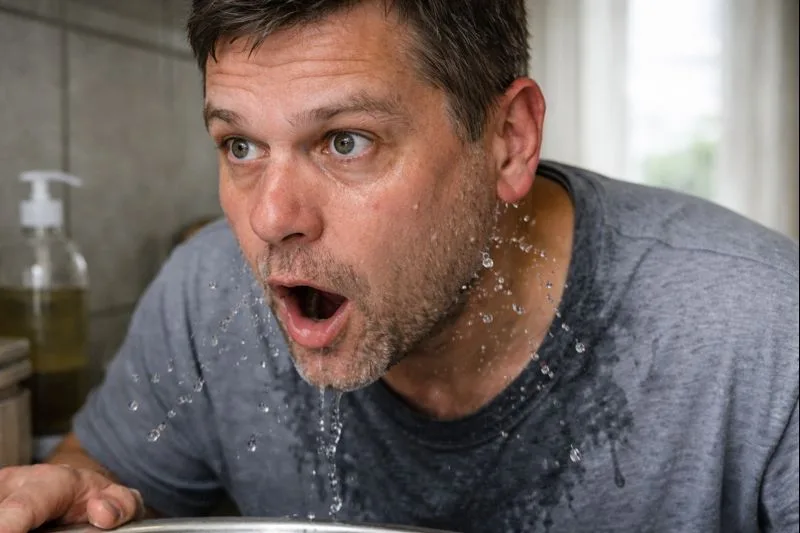
Cold gasp reflex test demonstrates how sudden exposure to cold triggers an immediate, involuntary spike in breathing, revealing how the nervous system prioritizes oxygen intake and rapid alertness under thermal shock.
You do not decide to inhale.
Your diaphragm contracts.
Your chest expands.
Air rushes in before thought arrives.
This sharp intake of breath — the gasp — is one of the fastest reflexes the human body produces. It exists to protect oxygen supply during abrupt environmental threat, especially cold exposure.
Cold air on the skin.
Cold water on the face or neck.
A sudden temperature drop.
The nervous system responds in milliseconds.
30-Second Self-Test: Triggering the Cold Gasp Reflex Safely
Use caution. Do not perform this test if you have asthma instability, cardiac rhythm disorders, or fainting history. Keep the exposure mild.
You will need:
- A small bowl of cool tap water or a cold compress
- A calm seated position
Steps:
- Sit upright and breathe normally for 20–30 seconds.
- Lightly splash cool water onto your face or press a cool cloth against the upper chest or neck for 1–2 seconds.
- Observe the immediate breathing response.
- Allow your breathing to normalize naturally.
Most people notice:
- A sudden involuntary inhale
- Brief chest expansion
- Momentary alertness spike
- Increased respiratory rhythm for a few seconds
- Subtle cardiovascular activation
The reaction occurs before conscious intention.
That timing is the key insight.
Why Cold Triggers Instant Breathing
The skin contains dense populations of thermoreceptors that detect rapid temperature change.
When cold receptors fire abruptly, sensory signals travel through peripheral nerves into the brainstem respiratory centers.
The nervous system interprets sudden cold as a potential environmental threat:
- Possible immersion
- Airway compromise
- Oxygen demand spike
- Loss of thermal stability
The fastest protective action is to increase oxygen intake immediately.
Breathing accelerates automatically.
This reflex bypasses cortical decision-making entirely.
The Brainstem Control Loop
Breathing is regulated by automatic neural circuits in the medulla and pons.
These centers integrate:
- Blood oxygen levels
- Carbon dioxide concentration
- Mechanical lung stretch
- Sensory input from skin and face
Cold sensory input acts as a strong external trigger that temporarily overrides baseline breathing rhythm.
The diaphragm contracts reflexively.
The airway opens.
Air rushes in.
This happens before you consciously register cold.
Why the Gasp Is So Strong
Evolution favored speed over subtlety.
If early humans suddenly entered cold water or cold air, delayed breathing could compromise oxygen availability or airway protection.
A sharp gasp:
- Rapidly increases oxygen intake
- Elevates alertness
- Primes muscular readiness
- Stabilizes respiratory rhythm
The reflex prepares the body for immediate environmental adaptation.
How This Differs From Voluntary Breathing
Voluntary breathing is slow, controlled, and conscious.
The cold gasp reflex is:
- Fast
- Automatic
- Involuntary
- Driven by sensory input
- Independent of intention
You cannot suppress the first gasp reliably.
Only after the initial reflex can conscious control resume.
The Link Between Cold Gasp and Stress Response
Cold exposure activates both respiratory and sympathetic nervous systems.
This causes:
- Increased heart rate temporarily
- Mild blood pressure elevation
- Heightened alertness
- Faster breathing
The body enters a brief mobilization state.
This overlap explains why cold exposure can feel both shocking and energizing.
Why Repeated Exposure Reduces the Reflex
If you repeat the test several times, the gasp often becomes weaker.
This is neural habituation.
The brain learns:
- The stimulus is not dangerous
- Oxygen threat is minimal
- No escalation is needed
The nervous system recalibrates its response threshold.
This plasticity demonstrates how reflex intensity adapts with experience.
Everyday Situations Where You Feel This Reflex
You experience the same mechanism when:
- Entering cold water suddenly
- Walking into cold wind unexpectedly
- Splashing cold water on your face
- Stepping into a cold shower
- Touching cold metal in winter
- Sudden air-conditioning exposure
The gasp is a universal human reaction.
The Difference Between Cold Gasp and Panic Breathing
Cold gasp is:
- Brief
- Reflex-driven
- Quickly self-correcting
- Sensory-triggered
Panic breathing involves:
- Sustained hyperventilation
- Cognitive feedback loops
- Emotional amplification
- Longer recovery time
The cold gasp reflex itself is not panic. It is a short physiological spike that stabilizes rapidly.
Why This Reflex Still Matters Today
Modern environments are temperature-controlled.
Yet the nervous system remains calibrated for unpredictable climates.
The reflex protects:
- Oxygen availability
- Airway readiness
- Rapid alertness
- Survival responsiveness
Your body still operates with ancient safety systems.
The cold gasp reflex test exposes one of the fastest.
Why This Belongs in Safe Extremes
This experiment explores:
- Involuntary respiratory control
- Rapid autonomic activation
- Sensory-to-brainstem coupling
- Immediate physiological prioritization
It pushes a real biological limit while remaining safe when mild and brief.
What This Test Reveals About Your Body
Breathing is not fully under conscious control.
Environmental signals can override intention instantly.
Your nervous system constantly monitors the external world and adjusts core physiology before awareness catches up.
You experience the result, not the command.
The Deeper Insight
Speed defines survival systems.
When milliseconds matter, the brain removes deliberation.
Cold exposure reveals how deeply automatic your breathing truly is.
Next Safe Extreme You Should Try
Face Dunk Breath Hold Test: How Cold and Breath Control Interact Inside the Nervous System
This experiment explores how cold stimulation and breath suppression interact to amplify autonomic reflex control and oxygen conservation.

Dr. Ethan Marlowe is a science communicator specializing in human biology, neuroscience, and the hidden mechanisms of the body. He focuses on transforming complex research into clear, engaging explanations that help readers understand how their bodies work. At The Human Body Facts, Ethan brings curiosity, accuracy, and a modern scientific approach to every article.