
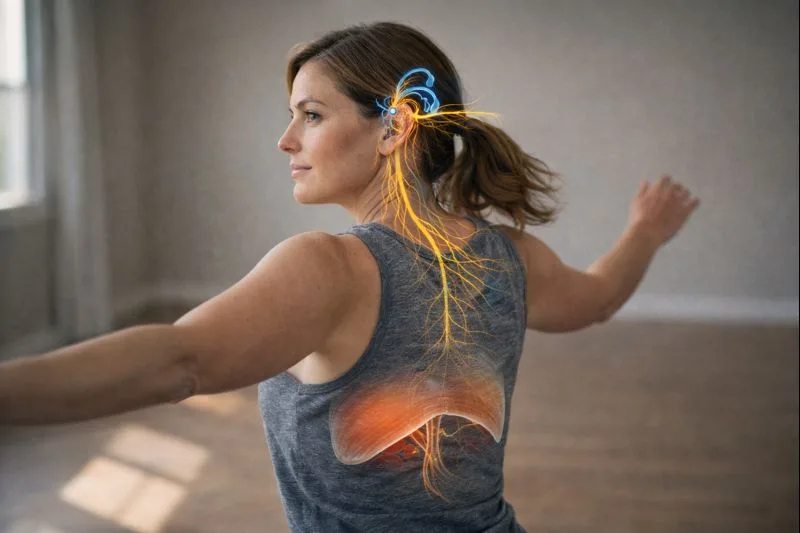
Quick spin orientation test shows how your nervous system rapidly recalibrates after sudden rotation — revealing an essential survival mechanism inside the vestibular system that keeps your balance, spatial awareness and stability in chaotic motion.
Spin your body quickly in place — just once — and notice what happens immediately afterward.
A moment of:
- dizziness
- spatial disorientation
- inner ear overload
- delayed visual reference
- balance instability
Yet within seconds, your system regains alignment, returning you to stability.
This rapid recovery is not random.
It is a built-in system designed to keep you upright and oriented even when your world suddenly tilts.
30-Second Self-Test: The Quick Spin Orientation Test
Here’s how to experience this safely:
- Stand in a clear space.
Make sure there’s room around you so you won’t trip or bump anything. - Plant your feet hip-width apart.
Keep your knees soft, torso upright. - Raise your arms to shoulder height.
This increases vestibular input and makes the effect clearer. - Turn your head gently 180° to one side.
Then rapidly rotate your torso in a controlled, circular motion — about one full spin. - Stop abruptly.
Keep your gaze fixed on a stable point in front of you. - Notice your balance.
The initial sensation may include:- slight room-tilt illusion
- a faint pull backward
- an almost imperceptible wobble
- a delayed recalibration of posture
This is normal.
Your inner ears and brain are collaborating to reset orientation.
Why the Body Loses Orientation During a Quick Spin
Your balance system relies on three core inputs:
- Vestibular signals from the inner ear (semicircular canals)
- Visual cues from your eyes
- Proprioceptive feedback from joints and muscles
When you spin quickly, the fluid inside the semicircular canals continues moving even after you stop, sending lagged signals to the brain.
The result?
Your nervous system temporarily believes your head is still turning, even when it has stopped. This creates illusions of movement and balance drift.
Your visual and proprioceptive systems then kick in to correct the error.
The brain integrates:
- the outdated vestibular signal
- the static visual reference
- feedback from muscles and joints
and rapidly adjusts orientation — often within just a few seconds.
That’s why the disorientation is brief but noticeable.
The Vestibular System: A Rapid Survival Mechanism
The vestibular apparatus exists inside your inner ear — three tiny “canals” arranged in perpendicular axes. They detect angular acceleration.
When you rotate:
- fluid shifts inside those canals
- hair-like receptors bend
- neural signals fire
- your brain computes the direction and speed
This happens before conscious awareness.
Evolutionarily, this system kept humans agile and stable when:
- climbing
- hunting
- escaping danger
- navigating uneven terrain
Our ancestors didn’t have smooth floors or stable chairs — they relied on rapid balance correction to survive.
Today, the same mechanism keeps you upright when you:
- pivot quickly in sports
- turn abruptly while walking
- rise after bending
- step off a moving surface
- look over your shoulder in a hurry
It’s automatic. Fast. Essential.
What Happens in the Brain During Re-Orientation
When vestibular signals conflict with visual or proprioceptive input, the brain faces a temporary mismatch. To resolve it, the nervous system:
- Suppresses outdated vestibular cues
- Prioritizes visual stability
- Uses proprioception to adjust posture
- Restores balance within ~2–10 seconds
This multi-signal integration happens subconsciously — you don’t think about it.
You just feel it.
That sensation of “stilling up” is your brain finishing the recalibration sequence.
Why the Quick Spin Orientation Test Feels So Immediate
Balance is one of the fastest integrative tasks the nervous system performs.
Vestibular neural circuits loop through:
- brainstem
- cerebellum
- motor cortex
- sensory nuclei
This loop is optimized for speed, not deliberation.
In fact, you often regain orientation before you consciously register the correction.
That’s why:
- dizziness fades quickly
- balance returns naturally
- visual focus sharpens almost instantly
- posture realigns without your direction
The system is built so that failure to recover quickly would be dangerous.
Everyday Situations That Use the Same Mechanism
The same recovery system activates when you:
- spin around while playing
- ride in a fast car
- pivot in basketball or tennis
- step off a train
- get up quickly after bending
- turn suddenly while hiking
- dance spinning patterns
- stand after a sudden head turn
Balance is not a static skill — it’s constant recalibration.
The Difference Between Vertigo and Normal Re-Orientation
Normal post-spin imbalance fades rapidly and is benign.
Vertigo, on the other hand, involves:
- inner ear pathology
- sensory mismatch overload
- prolonged imbalance
- nausea or discomfort
- abnormal neural signaling
The quick spin orientation test, as designed here, stays well within safe limits and triggers the normal neural correction mechanism — not pathological vertigo.
What This Test Teaches About Your Body
Balance is a collaboration between:
- sensory detection
- neural integration
- motor correction
- prediction vs correction loops
Your brain resolves conflicting signals faster than conscious thought.
The quick spin orientation test puts that process into awareness.
Next Safe Extreme You Should Try
Cold Face Diving Reflex Test: How Cold Water Instantly Slows Your Heart
This experiment explores how cold stimulation on the face activates ancient autonomic reflexes that rapidly slow heart rate, redistribute blood flow, and shift the nervous system into oxygen-conservation mode.

Dr. Ethan Marlowe is a science communicator specializing in human biology, neuroscience, and the hidden mechanisms of the body. He focuses on transforming complex research into clear, engaging explanations that help readers understand how their bodies work. At The Human Body Facts, Ethan brings curiosity, accuracy, and a modern scientific approach to every article.