
Rubber hand illusion allows your brain to adopt a fake limb as part of your body in just a few minutes through synchronized vision and touch.
Place one hand on a table.
Now hide it behind a book, a backpack, or any object that blocks your view.
In front of you, place a fake hand — a rubber hand if you have one, a glove stuffed with cloth, or even a sleeve shaped roughly like a hand. Align it so it visually matches where your real hand should be.
Look only at the fake hand.
Now gently stroke both hands at the same time: the fake hand you see and the real hand you feel.
Match the rhythm.
Match the location.
Match the timing.
After less than a minute, something subtle begins to shift.
The fake hand no longer feels like an object.
It starts feeling like part of you.
Not as imagination.
Not as role-play.
As a genuine perceptual change inside the nervous system.
60-Second Self-Test: Inducing the Rubber Hand Illusion
To strengthen the rubber hand illusion:
- Keep your gaze fixed on the fake hand.
- Maintain precise synchronization between both touches.
- Avoid touching the visible real hand.
- Stay relaxed and attentive.
Notice carefully:
- A growing sense of ownership over the fake hand
- A fading awareness of where your real hand is located
- A mild emotional attachment to the fake limb
- A reflexive discomfort if someone threatens the fake hand
Many people instinctively pull back if the fake hand is suddenly tapped or “attacked.”
Your nervous system reacts automatically — even when logic knows the hand is fake.
Your Brain Does Not Track Objects — It Tracks Sensory Agreement
The brain is not designed to verify physical truth.
It is designed to build a coherent model of the body using sensory consistency.
Three main signals determine body ownership:
- Vision → what you see
- Touch → what you feel on the skin
- Proprioception → where your body believes it exists in space
When these signals match in time and position, the brain binds them into a single representation.
If what you see matches what you feel, the brain assumes ownership — even if the object is artificial.
The rubber hand illusion exploits this rule directly.
The nervous system prioritizes coherence over accuracy.
The Body You Experience Is a Neural Model
Inside your brain exists a continuously updated internal representation called the body schema.
You never experience your physical body directly.
You experience the brain’s simulation of your body.
This simulation integrates:
- Sensory input
- Motor predictions
- Visual confirmation
- Timing alignment
- Error correction
When the fake hand receives synchronized input, the body schema expands to include it.
Ownership is not fixed.
It is computed moment by moment.
This is why the rubber hand illusion can override years of bodily certainty in seconds.
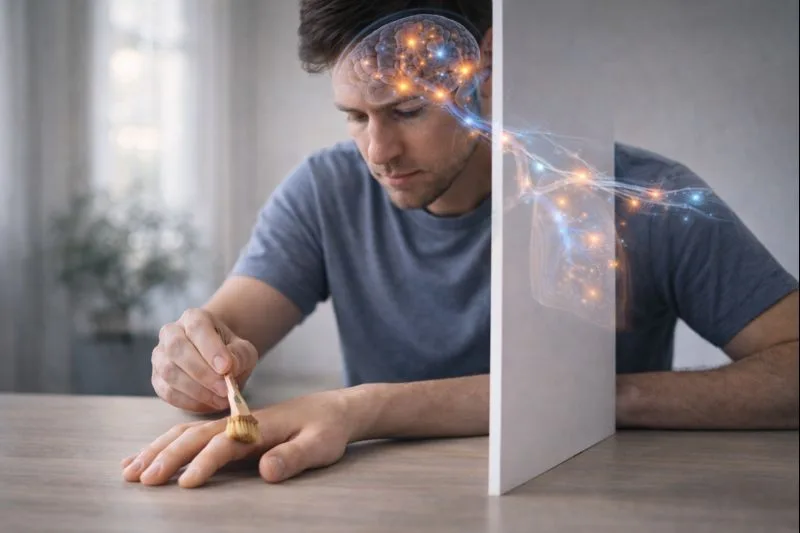
Why Timing Hijacks Ownership So Easily
Your nervous system constantly searches for causal relationships.
When two sensory events occur together repeatedly within a narrow time window, the brain assumes they originate from the same source. This process is known as multisensory binding.
The rubber hand illusion strengthens when:
- Touch timing is precisely synchronized
- The fake hand sits in a realistic position
- Visual attention remains stable
- Spatial alignment feels natural
The illusion weakens when:
- Timing drifts
- The hand looks unrealistic
- Alignment breaks
- Competing sensory signals appear
Your brain continuously tests coherence.
When coherence wins, ownership follows.
Emotional Proof: The Threat Reflex
One of the strongest demonstrations happens when the fake hand is threatened.
If someone suddenly pretends to stab, hit, or drop an object near the fake hand, most people show:
- Increased heart rate
- Skin conductance response
- Micro-withdrawal movements
- Emotional discomfort
The autonomic nervous system activates protective reflexes.
This happens even while consciously knowing the hand is artificial.
Body ownership operates below conscious reasoning.
How the Rubber Hand Illusion Appears in Everyday Life
The same mechanism allows:
- Tools to feel like extensions of the body
- Driving a car intuitively as if it were part of you
- Typing without monitoring finger positions
- Adapting to prosthetics
- Immersive virtual reality embodiment
- Phantom vibration sensations
Your brain absorbs whatever behaves consistently with your body model.
The boundary of “self” is flexible.
What This Reveals About Identity
Your sense of self is not anchored in biology alone.
It emerges from sensory integration.
Change the signals — and the experience of “me” changes.
The rubber hand illusion demonstrates that identity is a dynamic construction, not a fixed property.
Next Recommended Experiment
Continue with:
“Why You Feel Your Phone Vibrate When It Didn’t.”
This experiment explores how predictive brain circuits can generate physical sensations without any external stimulus, revealing how expectation shapes perception in everyday life.

Dr. Ethan Marlowe is a science communicator specializing in human biology, neuroscience, and the hidden mechanisms of the body. He focuses on transforming complex research into clear, engaging explanations that help readers understand how their bodies work. At The Human Body Facts, Ethan brings curiosity, accuracy, and a modern scientific approach to every article.