
The 30 second balance test exposes how your inner ear, nervous system, and posture control stability in real time.
Balance feels automatic, but it relies on a complex interaction between sensory organs, neural processing, and muscle coordination.
Small instability reveals how efficiently your brain integrates visual input, inner ear signals, and body position.
This experiment takes less than one minute and provides immediate feedback about your vestibular system performance.
Most people are surprised by how challenging a simple balance task becomes when sensory input is reduced.
What the 30 Second Balance Test Measures
The 30 second balance test evaluates vestibular control and neural integration.
Your balance depends on three main systems:
- Visual input from the eyes
- Proprioceptive feedback from muscles and joints
- Vestibular signals from the inner ear
The brain continuously compares these signals to maintain upright posture.
If one signal becomes unreliable, the brain must compensate using the remaining systems.
This test isolates how well your nervous system performs this integration under minimal sensory conditions.
How the Inner Ear Controls Balance
Inside your inner ear sits the vestibular apparatus.
It contains:
- Semicircular canals that detect rotational movement
- Otolith organs that sense linear acceleration and gravity
These structures are filled with fluid and microscopic hair cells.
When you move your head, fluid shifts and bends the hair cells.
This mechanical movement converts into electrical signals that travel to the brainstem and cerebellum.
The brain processes these signals to stabilize posture, eye position, and spatial orientation.
Any delay or mismatch in this system produces wobbling or loss of balance.
How to Perform the 30 Second Balance Test
Consistency matters for meaningful results.
Setup
Stand barefoot or with flat shoes on a stable surface.
Choose a quiet space free from obstacles.
Keep your arms relaxed by your sides.
Have a timer ready for thirty seconds.
Execution
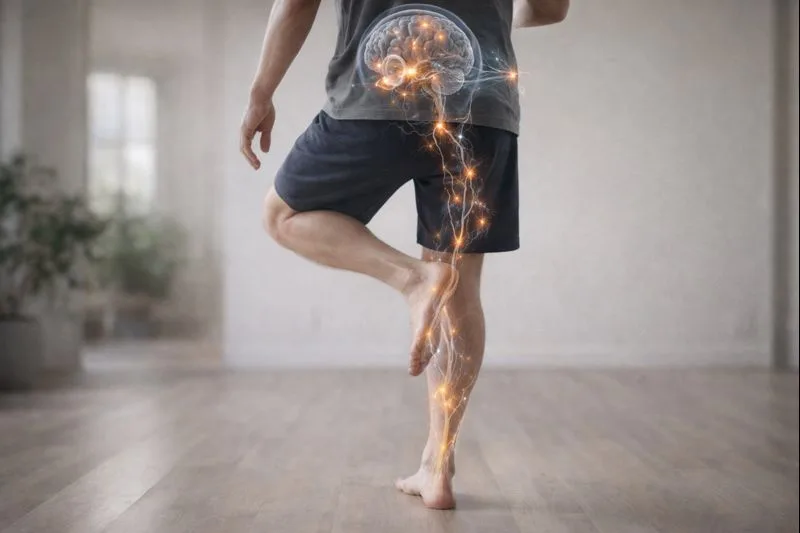
Lift one foot slightly off the ground.
Fix your gaze on a stationary point in front of you.
Start the timer.
Maintain balance for thirty seconds without touching the ground.
If you lose balance, reset and try again.
Repeat the test with the opposite foot.
Optionally repeat with eyes closed for increased difficulty.
What Your Results Reveal
Balance performance varies widely between individuals.
Age, physical activity, vision quality, and inner ear health all influence results.
Strong Balance Control
If you maintain stability easily:
- Your vestibular system is functioning efficiently
- Neural integration between sensory systems is strong
- Postural muscles are well coordinated
- Proprioceptive feedback is accurate
Athletes, dancers, and physically active individuals often demonstrate superior balance stability.
Moderate Balance Control
Mild wobbling is normal.
It reflects healthy but non-optimized sensory integration.
Small adjustments indicate active neural correction mechanisms.
Weak Balance Control
Frequent instability may be influenced by:
- Fatigue
- Dehydration
- Inner ear congestion
- Vision strain
- Muscle weakness
- Poor posture habits
Occasional imbalance is normal, but persistent difficulty may require medical evaluation.
Why Closing Your Eyes Changes Everything
Vision provides powerful spatial reference.
When eyes close, the brain loses visual anchoring.
The nervous system must rely more heavily on vestibular and proprioceptive input.
If those systems are undertrained or fatigued, instability increases rapidly.
This demonstrates how strongly the brain depends on visual cues for postural control.
Neural Processing Behind Balance Stability
Balance control involves continuous neural feedback loops.
Sensory receptors send signals to the cerebellum.
The cerebellum predicts movement corrections.
Motor commands adjust muscle tension in milliseconds.
Postural muscles in the ankles, hips, and core stabilize the body.
This loop operates subconsciously hundreds of times per second.
Any disruption in signal timing or accuracy reduces stability.
Factors That Affect Your 30 Second Balance Test
Several physiological variables influence balance performance.
Sleep Quality
Sleep deprivation reduces neural coordination and reaction precision.
Balance becomes less stable after poor sleep.
Hydration
Inner ear fluid balance depends on hydration levels.
Dehydration can impair vestibular signaling.
Neck and Posture Alignment
Forward head posture alters vestibular calibration.
Neck stiffness reduces proprioceptive feedback accuracy.
Screen Exposure
Extended screen use fatigues eye muscles and visual processing centers.
Visual strain destabilizes spatial perception.
Stress Levels
High cortisol interferes with motor coordination and sensory integration.
Relaxed states improve postural control.
Can Balance Be Trained
Yes. Balance improves through targeted neural stimulation.
Training enhances sensory integration efficiency and muscular coordination.
Effective methods include:
- Single-leg standing drills
- Stability board exercises
- Yoga balance poses
- Slow controlled movement training
- Barefoot proprioception exercises
Consistent practice strengthens vestibular adaptation and neural responsiveness.
Safety Considerations
Always perform the test near a stable surface.
Avoid closing your eyes if dizziness is present.
Stop immediately if vertigo or nausea occurs.
This experiment is not intended for diagnosing medical conditions.
Persistent balance issues require professional assessment.
Why Micro Balance Tests Improve Body Awareness
Short balance challenges increase sensory awareness.
They reveal how posture, hydration, and fatigue influence neural control.
They promote conscious movement and posture correction.
They build long-term vestibular resilience.
These experiments transform invisible neural processes into tangible feedback.
Next Recommended Experiment
Continue with:
“Cold Hand Test: How Fast Does Your Blood Flow Adapt to Temperature?”
This experiment explores vascular reflexes and nervous system regulation.

Dr. Ethan Marlowe is a science communicator specializing in human biology, neuroscience, and the hidden mechanisms of the body. He focuses on transforming complex research into clear, engaging explanations that help readers understand how their bodies work. At The Human Body Facts, Ethan brings curiosity, accuracy, and a modern scientific approach to every article.